
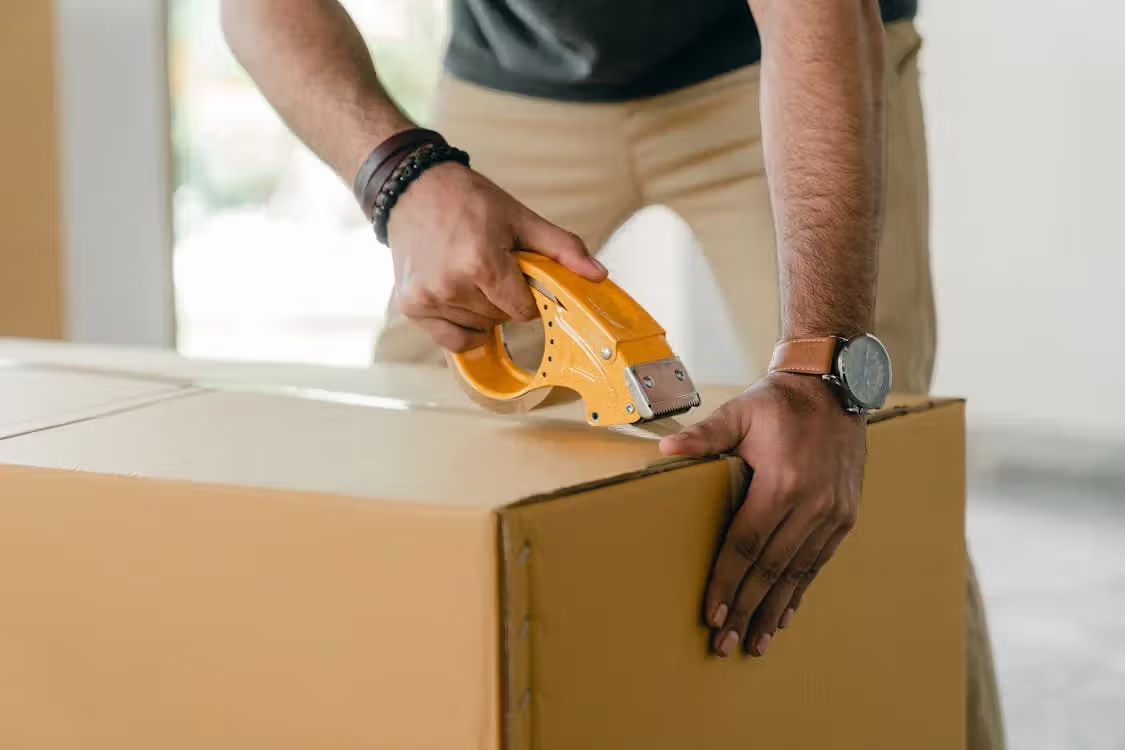
The concept of reverse logistics has become indispensable in modern commercial activity, and the five “R’s,” a useful mnemonic from the world of logistics, hold a central place in the calculations of many business owners and managers.
In this article, we will look at what it is about.
What is reverse logistics?
The explanation is simple, although the concept is broad. The term refers to the movement of products in the opposite direction to the conventional one, that is, from the consumer to the producer or store.
It is a notion that has acquired special importance in today’s commerce, largely due to the growth of e-commerce and the context created by parcel shipping to the end customer, instead of the traditional in-person purchase.
The importance of reverse logistics
As is logical, logistics chains are designed for the movement of products in the direction of the consumer, so the opposite movement poses special challenges. However, reverse logistics is now highly important for companies.
For example, the returns policy is one of the main considerations for those who shop online. On another level, concern for sustainability places emphasis on the reuse of materials.
The 5 “R’s”
The five “R’s” of reverse logistics are the five main types of product return: return, resale, repair, replacement, and recycling. Let us define each one more specifically and see the kind of solutions that can be found.
1. Returns
A product may be returned for many reasons, such as incorrect or damaged orders. There should be an established procedure for receiving, inspecting, and testing returned products.
Ideally, when it comes to product returns, of course, they should be avoided. Steps in that direction include careful handling during transport, improving order processing so that there are no mistakes, and providing complete and clear product descriptions as well as photographs.
2. Resale
The preferred destination for the item that goes back to the seller is, of course, resale. This is the most efficient way, when possible, to use the returned product.
And it is possible in most cases: most returns in online commerce do not happen because there is any problem with the item, but because the customer is not satisfied with it. The first step for resale is to test the item to verify that there is no problem and repack it. Many companies take advantage of sales periods to market returned items, offering an additional discount price, thus supplementing and enhancing the sales.
3. Repairs
In many cases, what is needed is the repair of a given product, rather than its final return.
Even if the solution involves sending a new product to the customer, for example in the name of immediacy, it may make sense to repair the item in order to reuse it. Many companies sell products, after repair, labeled as “refurbished.” Defective products can sometimes be sold at a discount, with the defect indicated.
Another option that may be worth considering, depending on the type of business, is to offer an at-home repair service.
4. Replacement
A common case in e-commerce is the customer who wants the same product, but in a different version: after all, the sweater is too small; or that color of the new phone looked better in the photo.
Providing an easy and simple procedure to return and replace the item with a new one with the desired changes is an extremely important way to satisfy your customers and promote good retention rates.
5. Recycling
With the centrality of environmental issues in modern times, sustainability has assumed increasing importance in companies’ practices and consumers’ purchasing habits.
Investing in the recycling of materials, whether at the product or packaging level, makes a positive impression on the public and can be an essential factor in many people’s decisions. In addition, it can be a profitable strategy for reducing costs.
InPost: the right approach to returns
Finding the right balance between the costs associated with reverse logistics and the need to meet customer expectations is a challenge that is usually easier for large companies than for smaller businesses. That is one of the reasons why it can be advantageous to enter into a logistics partnership.
An effective and hassle-free returns process is an absolutely crucial consideration for today’s companies. This is one of the most important factors in digital commerce, and most people check the returns policy before making a purchase online.
InPost represents a highly advantageous approach to reverse logistics for companies and customers, with our extensive network of PUDO points and Lockers. Visit our website and explore this blog to discover more about this and many other advantages that we have to offer you.
Related articles
Recommended articles

Jul 16, 2026
6 Tips to Optimize Your Company Shipments
Discover 6 tips to optimize your company shipments, reducing costs, improving sustainability and increasing customer satisfaction.
Jul 16, 2026
How to Build More Sustainable Consumption Habits
Discover practical tips to adopt more sustainable consumption habits and reduce your environmental impact in everyday life.