
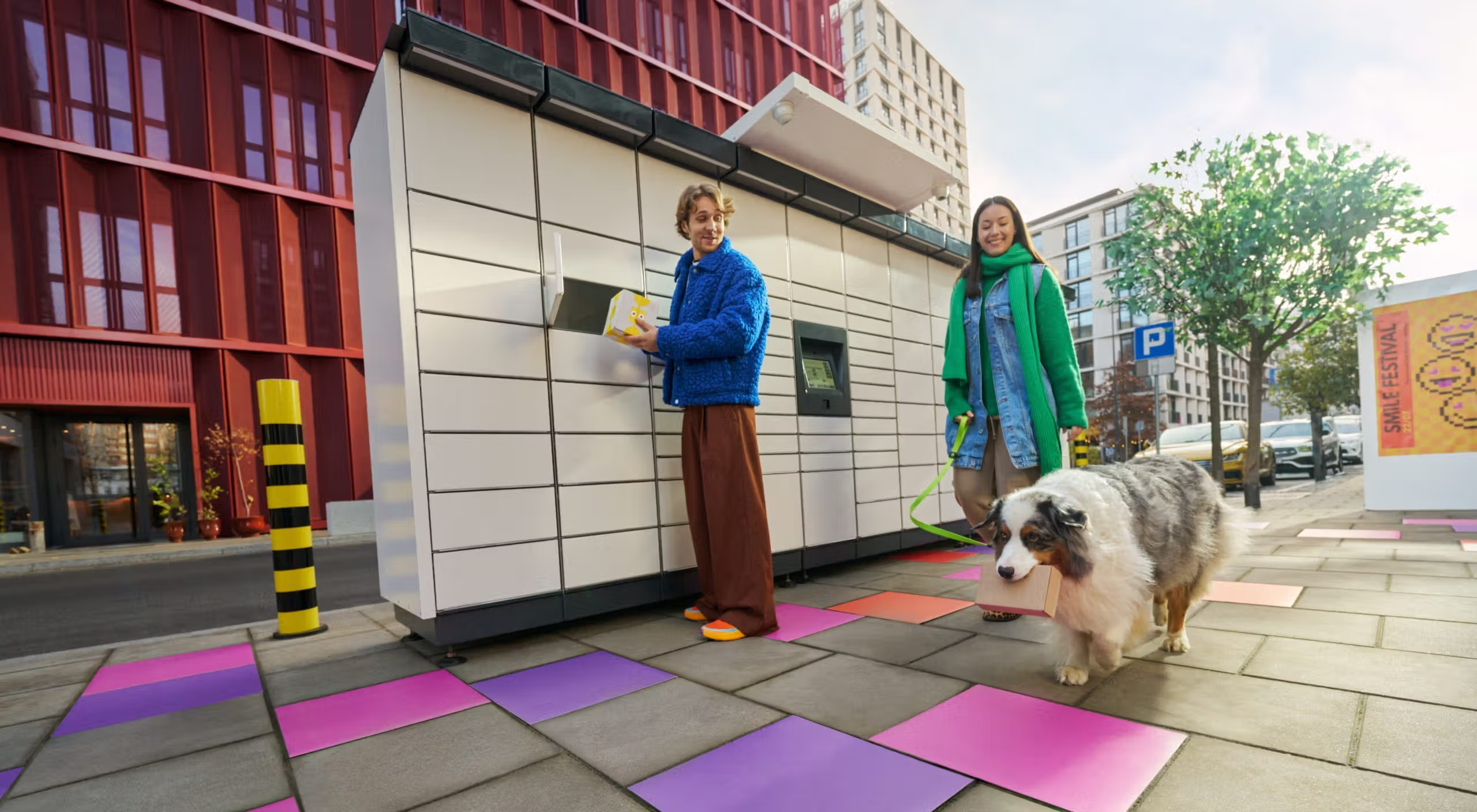
Today’s commercial world is complex, and it is difficult to fully understand or even stop to think about all the processes involved in a purchase or sale.
The way an order reaches its destination, for example, whether it is a home or a pickup point, involves a variety of sophisticated technology. Modern logistics strategy requires fine-tuned algorithms and well-organized data.
In this article, we want to offer an overview of the “behind the scenes” of the last mile and show the innovations that are being used to streamline the transport process, from the VRP concept to predictive AI systems that can already anticipate things even before the customer clicks.
What is VRP and why is it fundamental in last-mile logistics?
The Vehicle Routing Problem (VRP) is one of the great challenges of logistics. It is about finding the most efficient route to distribute each order, taking into account a whole set of variables, such as:
- The distance between points
- Vehicle capacity
- The available time windows for delivery
- Traffic and weather conditions
With the right algorithms, it is now possible to calculate optimized routes in seconds. The result? Faster deliveries, of course, fewer kilometers traveled, and more efficient logistics.
From classic algorithms to predictive artificial intelligence
While traditional VRP focuses on finding the best route for today, intelligence goes one step further: it seeks to anticipate the future behavior of customers and the logistics network.
It does so by analyzing millions of historical data points: orders, returns, locations, peak hours. It detects purchasing and delivery patterns thanks to AI models trained for that purpose.
From there, it adjusts resources (such as vehicles, lockers or routes) based on forecast demand. And it can do so in real time, automatically, without the need for last-minute reactions.
For example, if deliveries in a specific area of a city usually increase on Monday afternoons, AI can anticipate this and reinforce that route or free up more compartments in lockers. The goal is to gain more forecasting ability, fewer surprises, and deliveries that arrive precisely when they should.
What kind of algorithms make this possible?
Behind every optimized delivery are advanced models that keep learning and improving every day:
- Metaheuristics such as GRASP or Simulated Annealing, which find efficient solutions in record time.
- Neural networks, which predict demand according to customer behavior.
- Geographic clustering, to group deliveries close to one another and avoid scattered routes.
- Supervised machine learning, which adjusts the models as more data is collected.
The result is fewer kilometers, lower carbon emissions, and faster deliveries. A threefold success: for the business, for the customer, and for the environment.
What do companies gain from this technology?
Adopting AI-based technology not only improves delivery speed, but also transforms the way your company can manage logistics operations:
- Lower logistics costs: fewer kilometers, less fuel, and fewer unforeseen issues.
- Better customer experience: on-time, more precise deliveries, and real-time tracking.
- Smarter decisions: based on real data, not assumptions.
- Real scalability: the system automatically adjusts when demand grows.
And what comes next?
Artificial intelligence keeps evolving. For logistics for businesses, this means taking bigger steps:
- Reinforcement algorithms to improve logistics processes autonomously.
- Real-time simulation, to anticipate unforeseen events before they occur.
- Connection with smart cities, urban sensors, and shared mobility.
- More precision, more efficiency, and more sustainability.
For all these reasons, the logistics of the future will not only be faster, but also cleaner and more efficient.
Discover how InPost can help you to manage your shipments in a way that meets today’s challenges and keeps its eyes on the future.
Related articles
Recommended articles
Jul 16, 2026
6 Tips to Optimize Your Company Shipments
Discover 6 tips to optimize your company shipments, reducing costs, improving sustainability and increasing customer satisfaction.
Jul 16, 2026
How to Build More Sustainable Consumption Habits
Discover practical tips to adopt more sustainable consumption habits and reduce your environmental impact in everyday life.