
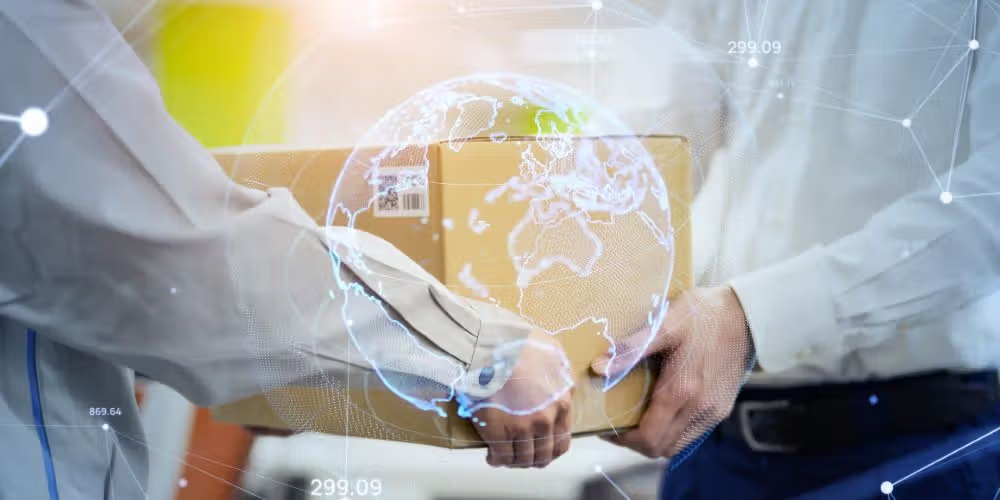
Next, we will talk about everything you need to take into account if you want to turn your online store into a cross-border e-Commerce.
It is normal for an online store to start selling within its own borders, but if it succeeds, it may approach other international markets. That is the key moment in its evolution as a company, which also entails many challenges to be overcome. In this article, we are going to tell you everything you need to take into account if you want to transform your online store into a cross-border e-Commerce.
The literal translation of the term “Cross Border” means transnational. This term is used to define commercial export operations. In other words, it is the process that allows companies to offer their products in other countries. It is a concept that is widely used in the fields of commerce, logistics, and customs regimes.
In any case, if you are thinking of something very labor-intensive, such as setting up warehouses all over Europe, you are mistaken. Cross Border is a trend that has become very strong throughout the online market, and allows companies to reach a different audience with minimal investment and without taking on great risks.
When we talk about a cross-border e-Commerce, we are talking about the internationalization of online stores.
All countries go through complicated economic cycles, and when competition is fierce in any of them, there is no other solution but to discover new markets in order to diversify profits. Thus, if in Portugal the economy goes through a delicate situation, it is possible that in other countries, such as Spain, France or, for example, Italy, the situation will be inviting for expansion into those markets.
E-commerce has a major advantage over traditional commerce: it is not necessary to open physical headquarters in other countries; everything is managed online, which means investments are much lower and the process itself is not complex.
Although we have said that the internationalization process for an e-Commerce is not as tedious as for a physical store, there are a number of steps to follow when selling to other markets.
It is essential to offer, in each country, a website in the local language. In other words, if you have a website in Portuguese and are thinking of starting to sell your products in France, you need to have a website developed in French. Leave automatic translations aside, and hire native people to do translations adapted to the customs of French consumers.
Another very important thing is to have the corresponding payment methods available. If they are countries in the European Union, perhaps the payment methods will not vary much. On the other hand, if you plan to start selling, for example, to Canada or any other country, you should find out well about the most commonly used payment methods in those countries.
It is also important to think about the currency of each country. If the currency of your potential market is not the euro, you should find out well about the fees of the platforms and payment installments you plan to use.
Another point not to forget is SEO, search engine optimization, so that customers can find your online store when they search on Google. Customer service is worth its weight in gold and the competition for every click is relentless. No matter how good the product you offer is, if you do not appear in the top positions in search engines, it is of little use. As they always say, there is no better place to hide an elephant than on the second page of Google.
Lastly, we come to shipping methods. You have to carefully analyze the habits of consumers in each country. Nowadays, the trend of parcel deliveries to pick-up points is gaining more and more weight, and this is where we, as InPost, want to help you.
There is no universal recipe to succeed in all markets in the same way. There are many variables at play, and success depends both on the product you offer and on the market you want to enter.
Often you have to go through a testing phase, through trial and error, and be patient. Even so, by having an e-Commerce you are already far ahead of traditional businesses. You have to overcome barriers, yes, but also without moving from your country, without opening physical stores, without making large investments. We assure you that the effort is worth it, and the reward will be very beneficial.
Related articles
Recommended articles

Jul 16, 2026
6 Tips to Optimize Your Company Shipments
Discover 6 tips to optimize your company shipments, reducing costs, improving sustainability and increasing customer satisfaction.
Jul 16, 2026
How to Build More Sustainable Consumption Habits
Discover practical tips to adopt more sustainable consumption habits and reduce your environmental impact in everyday life.