
Anyone who has ever run a race knows it: the final part of the route requires a special effort. And it is good that the drive that has taken us so far does not falter when we are almost at the finishing line.
The last mile of logistics requires its own specialization and effort, and it is essential for business activity in today’s times to have a perspective on its complexities.
In this article, we will explore the concept of the last mile, its dilemmas, and the solutions to these that the future may reveal.
The last mile, or last kilometer – an expression that emerged as a direct translation of the English last mile – refers to the final part of the journey in the shipping of a parcel, which typically starts on the warehouse shelf at the distribution center and ends with the end customer. The term can also be used in other contexts, such as telecommunications or passenger transport.
As we will see, due to the specific characteristics of this stage of the process, it makes sense to think of the last mile as an individual concept, a “world in itself,” and it is an area that is increasingly studied and analyzed.
The growth of online commerce, which intensified since the lockdown, and the increase in parcel delivery volume that accompanies it, mean that issues related to the last mile are becoming increasingly relevant.
This is especially clear in light of the fact that it is one of the most important factors for customer satisfaction and loyalty. Expectations in terms of speed, convenience, and service quality are high, and failing to meet them can have heavy consequences for companies.
Due to the costs and complications involved in this operational phase – just think of everything that maintaining and operating a vehicle fleet entails, in the case of companies that do their own deliveries – there is a strong emphasis on efficiency. A well-thought-out and well-executed strategy provides an enormous return and can make all the difference.
The use of the expression “last-mile problem” has become common in the business world to refer to the fact that the final stretch of the product’s journey until it reaches the consumer’s hands is often the one that involves the highest costs. This happens due to the difficulties involved in capillary distribution.
For example, in rural areas, there are fewer resources available and fewer parcels to deliver, so it is necessary to travel greater distances between deliveries, which increases the cost of each one. In cities, on the other hand, there is the problem of traffic, navigation issues, and the large volume of parcels to process.
There is also a high level of expectations on the part of the customer. These expectations involve not only delivery speed, but also other key factors, such as process transparency, represented by the possibility of tracking the parcel. Additionally, and particularly in the case of online commerce, in which there is often no direct contact between the company and the customer other than through delivery, it is obviously important to have a transport service that conveys an image of professionalism and care, whether this service is in-house or outsourced to a third party.
Finally, the growing number of parcels has created an urgent problem in terms of sustainability. The CO2 emissions generated, car traffic, and the strain on infrastructure are now a major concern, and studies in the field predict that the situation will continue to worsen if nothing is done.
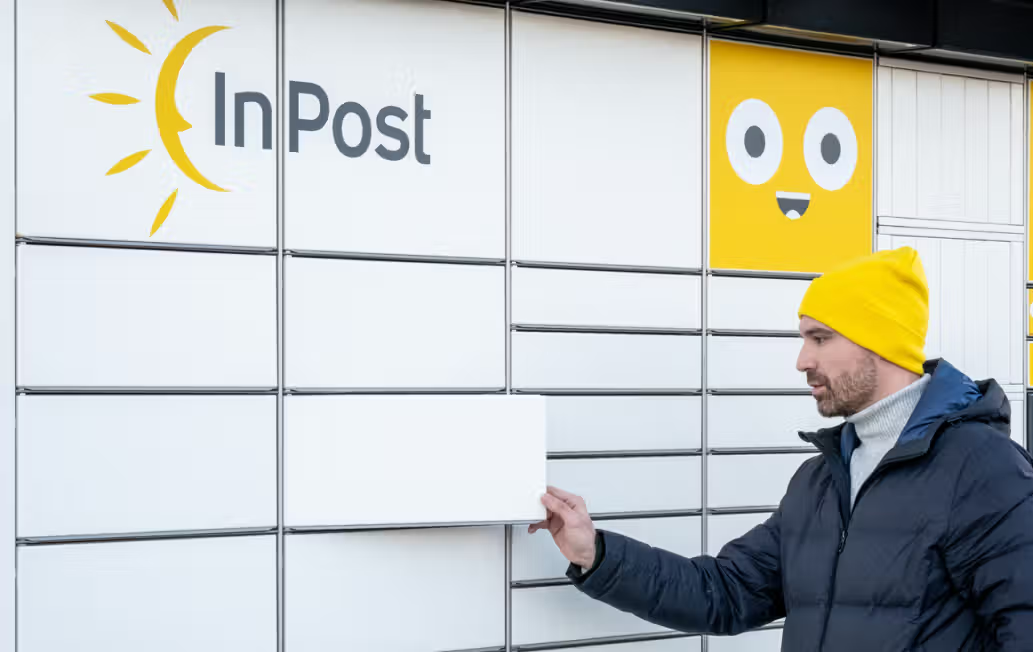
There is currently a need to find new solutions for the last mile, and that is the context for InPost’s action. Our approach has established itself as a highly advantageous and increasingly popular strategy, based on delivery to NOT home addresses. The use of Pontos Pack and Lockers makes it possible to combine speed, convenience for the customer, and concern for sustainability. We believe this is the way of the future.
Visit our website to find out more about the advantages of this strategy and take the first step toward a new last mile today.
Related articles
Recommended articles

Jul 16, 2026
6 Tips to Optimize Your Company Shipments
Discover 6 tips to optimize your company shipments, reducing costs, improving sustainability and increasing customer satisfaction.
Jul 16, 2026
How to Build More Sustainable Consumption Habits
Discover practical tips to adopt more sustainable consumption habits and reduce your environmental impact in everyday life.